
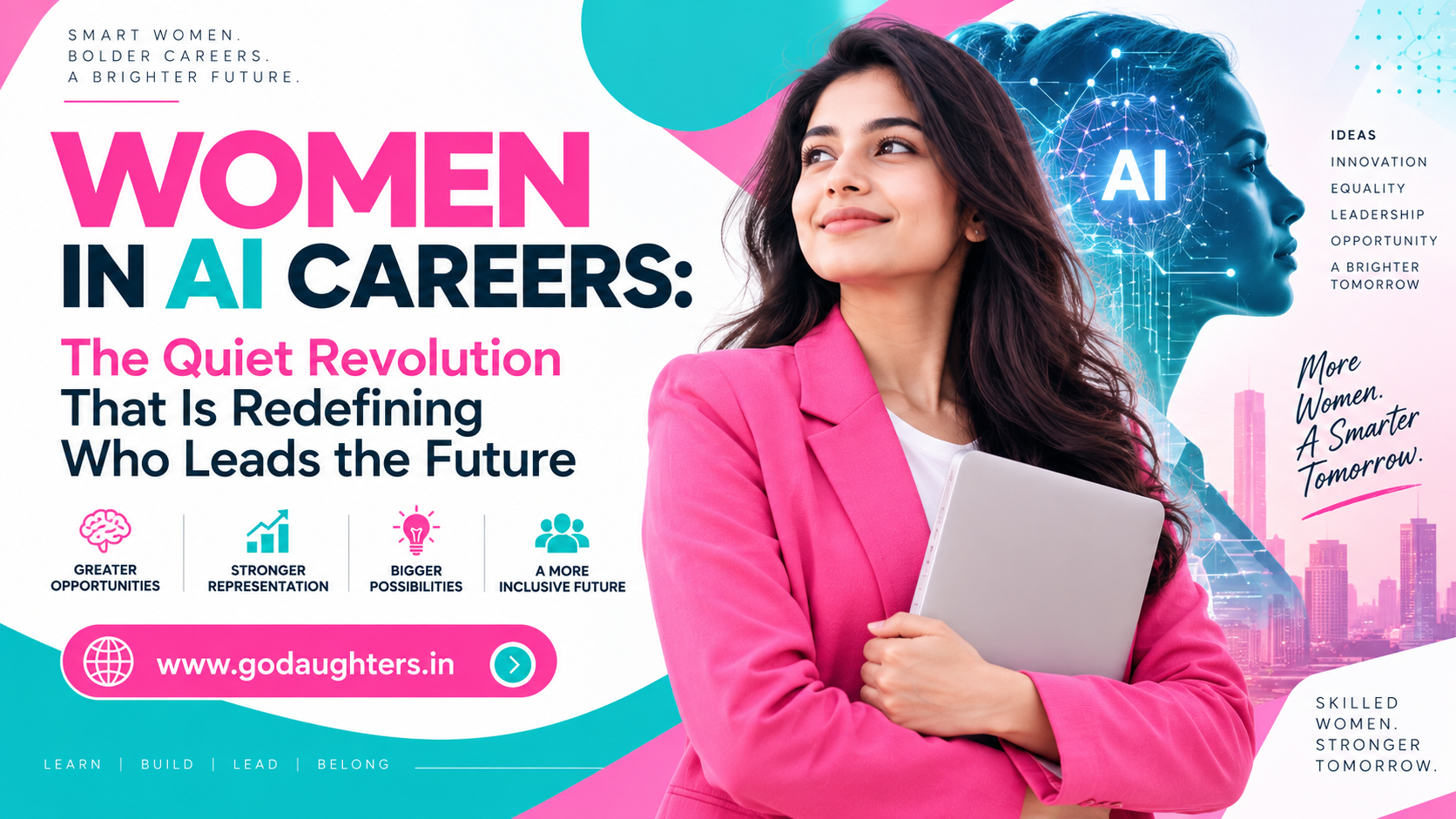


Introduction: The Future of AI Cannot Be Built Without Women
Artificial intelligence is no longer a distant idea reserved for laboratories, technology giants, or computer scientists. AI is becoming part of how businesses operate, how governments make decisions, how education is delivered, how healthcare evolves, and how societies communicate. But as the world rushes toward an AI-powered future, one question deserves far more attention: where are the women who will shape it?
I believe women cannot afford to watch the AI revolution from the sidelines.
We are living through one of the most significant technological transformations in human history. The decisions being made today about artificial intelligence will influence careers, economies, education, entrepreneurship, healthcare, security, communication, and opportunities for generations to come. If women are absent from these conversations, we risk building a future that does not fully understand the needs, experiences, ambitions, and realities of half of the world’s population.
Women in AI careers are not simply entering another growing industry. They are entering a field where they have an opportunity to influence the direction of the future itself.
As the Founder of Go Daughters and Co-Founder of 28 Credentials of Entrepreneur, I strongly believe that empowering women means preparing them not only to participate in tomorrow’s economy but to lead it.
And AI is one of the places where that leadership must begin.
Why Women in AI Careers Matter More Than Ever
For years, technology has been described as a field of innovation. But innovation is not only about algorithms, software, machines, or data. True innovation comes from understanding people.
Artificial intelligence learns from data created by society. It influences people, makes recommendations, supports decisions, and increasingly interacts with human lives. That means the people designing, developing, managing, regulating, and using AI need to understand diverse human experiences.
Women bring perspectives that can strengthen this process.
When women participate in AI research, product development, entrepreneurship, leadership, education, policy, and governance, they contribute perspectives that might otherwise be overlooked. Their involvement can help organizations ask better questions, identify overlooked users, understand different experiences, and build technology with greater awareness of its social impact.
This is not about suggesting that every woman thinks the same way. Women are not a single category with a single perspective. The real value lies in diversity of experience, expertise, culture, education, profession, age, geography, and worldview.
The AI industry needs that diversity.
The world needs women not merely as users of AI, but as creators, decision-makers, researchers, entrepreneurs, executives, educators, policymakers, and responsible leaders.
AI Is Creating More Career Opportunities Than Many Women Realize
When people hear “AI career,” they often imagine a programmer sitting behind multiple screens writing complex code.
That picture is incomplete.
AI careers extend far beyond traditional software engineering.
Women can build careers in AI research, machine learning, data science, AI product management, AI ethics, responsible AI, cybersecurity, business intelligence, AI marketing, prompt engineering, AI education, technology consulting, policy, governance, entrepreneurship, content creation, customer experience, operations, automation, healthcare technology, financial technology, and many other areas.
A woman does not necessarily need to become an advanced programmer to build a meaningful career around artificial intelligence.
A marketing professional can learn how AI is transforming customer behavior and marketing strategy.
A teacher can become an AI educator.
A lawyer can specialize in AI governance, technology regulation, and responsible innovation.
A healthcare professional can explore AI-powered healthcare systems.
An entrepreneur can use AI to automate operations, understand customers, develop products, and compete internationally.
A communications professional can specialize in AI-powered communication and content systems.
A young graduate can develop technical skills and enter emerging technology roles.
The opportunity is much bigger than a job title.
The opportunity is to understand where technology is going and position yourself before the market becomes saturated.
The Biggest Mistake Women Can Make Is Waiting to Feel Ready
One of the biggest barriers to entering AI careers is not always access to technology.
Sometimes it is confidence.
A woman may look at an AI professional and think, “I am not technical enough.”
Another may think, “I am too old to start.”
Someone else may think, “I don’t have the right degree.”
A young woman may believe, “There are already too many experts. Why would anyone listen to me?”
These thoughts can become invisible walls.
But the truth is that almost every major technological transformation creates room for people who are willing to learn.
You do not need to know everything before you begin.
You need the courage to begin learning.
The AI landscape is evolving so quickly that even experienced professionals are constantly learning. New tools emerge. New business models appear. New risks become visible. New careers are created. Skills that were valuable yesterday can change tomorrow.
That means curiosity is becoming one of the most valuable career advantages.
If you are waiting until you understand everything about AI before entering the field, you may wait forever.
Start with what you can learn today.
Then learn what comes next.
Women Must Move From AI Consumers to AI Creators
We already live in a world where millions of people use AI tools.
But using technology and shaping technology are two very different things.
Women must move beyond simply consuming AI-generated content, using AI assistants, or experimenting with popular tools.
We must ask bigger questions.
Who is building these systems?
What problems are they solving?
Who benefits from them?
Who might be excluded?
How should AI be governed?
How can AI create opportunities for women and girls?
How can entrepreneurs use AI responsibly?
How can education prepare young women for an AI-driven economy?
How can AI improve access to knowledge?
How can technology support communities that have historically been overlooked?
These questions require leadership.
And leadership requires participation.
The AI Gender Gap Is Not Just a Technology Problem
The gender gap in technology has existed for decades. AI does not automatically eliminate that gap.
In fact, if women are not deliberately encouraged to enter AI careers, emerging technologies could reproduce some of the inequalities already present in society.
That is why conversations about women in AI should not begin only when women are already successful.
They should begin much earlier.
They should begin in schools.
They should begin in universities.
They should begin in families.
They should begin in entrepreneurship programs.
They should begin in professional development.
They should begin when a young girl first says, “I want to build something.”
That girl should hear, “You can.”
She should not be told that technology is only for boys.
She should not be made to believe that leadership belongs somewhere else.
She should be given access to knowledge, mentorship, technology, confidence, and opportunities.
This is one of the reasons initiatives focused on empowering girls and women matter so deeply.
If we want more women leading AI tomorrow, we have to prepare girls today.
From the Classroom to the Boardroom
The journey toward a career in AI does not have to follow one traditional path.
A young woman might begin by learning basic digital skills.
She might explore AI tools.
She might take online courses.
She might participate in technology communities.
She might build small projects.
She might attend conferences.
She might find a mentor.
She might join an internship.
She might launch an AI-focused business.
She might eventually lead a technology company.
There is no single route.
What matters is movement.
Every skill learned creates another possibility.
Every conversation can create another connection.
Every project can become another credential.
Every failure can become another lesson.
The goal is not to become an AI expert overnight.
The goal is to become more capable every month.
Women Entrepreneurs Have an Extraordinary Opportunity
AI is particularly powerful for women entrepreneurs because it can reduce some of the barriers that traditionally make entrepreneurship difficult.
A small business owner can use AI to support market research, customer communication, content development, administrative work, business analysis, workflow automation, and many other tasks.
This does not mean AI replaces human entrepreneurship.
It can amplify it.
A founder who understands how to combine human judgment with intelligent technology can potentially operate more efficiently and compete in markets that previously seemed inaccessible.
For women building businesses with limited teams or resources, learning to use AI strategically can become a significant advantage.
But there is an important distinction.
AI should not replace your thinking.
It should strengthen it.
The entrepreneur still needs vision.
The leader still needs judgment.
The business still needs trust.
The customer still needs empathy.
Technology can accelerate execution, but human leadership determines direction.
The Future Belongs to Women Who Learn Continuously
The traditional idea of a career was relatively straightforward.
You studied.
You graduated.
You got a job.
You gained experience.
You climbed the ladder.
AI is disrupting that model.
The future of work will increasingly reward people who can learn, adapt, experiment, collaborate, and reinvent themselves.
This creates an enormous opportunity for women.
A woman who has been working in one industry for ten years does not necessarily need to abandon her experience to enter AI.
She can combine her existing expertise with AI.
That combination can be powerful.
Imagine an experienced finance professional who learns AI analytics.
Imagine a teacher who learns AI-powered education tools.
Imagine a healthcare professional who understands AI applications in patient care.
Imagine a lawyer who develops expertise in AI governance.
Imagine a businesswoman who learns automation.
The future will not necessarily belong to people who know only technology.
It may belong to people who understand technology and know how to apply it to real-world problems.
AI Leadership Needs Ethics, Empathy and Responsibility
There is another reason women must be part of the AI conversation.
The future of artificial intelligence is not only a technical question.
It is a human question.
AI can create tremendous opportunities, but it also raises serious questions about privacy, bias, misinformation, employment, security, accountability, transparency, and the responsible use of technology.
We need leaders who understand that innovation without responsibility can create problems as quickly as it creates opportunities.
Women must have a seat at these tables.
Not because women should be treated as symbolic representatives, but because leadership becomes stronger when decision-making includes a broad range of experiences and expertise.
AI needs engineers.
AI needs entrepreneurs.
AI needs scientists.
AI needs educators.
AI needs policymakers.
AI needs designers.
AI needs lawyers.
AI needs communicators.
AI needs ethicists.
And AI needs women in all of these roles.
Stop Saying “I Am Not a Technology Person”
I want women reading this to challenge one sentence immediately.
“I am not a technology person.”
Perhaps you are not today.
But that does not mean you cannot become one.
Nobody is born understanding artificial intelligence.
Nobody is born knowing how machine learning works.
Nobody begins as an expert.
Skills are learned.
Confidence is developed.
Knowledge is built.
And careers evolve.
If technology intimidates you, start small.
Learn one concept.
Use one tool.
Watch one educational lesson.
Read one credible article.
Speak to someone working in the field.
Build something simple.
Then repeat the process.
Small steps taken consistently can create a completely different professional future.
What Women Should Start Doing Now
The urgency is real because the AI economy is developing now.
Do not wait for the future to arrive before preparing for it.
Begin by understanding the fundamentals of artificial intelligence. Learn what AI can and cannot do. Understand the difference between generative AI, machine learning, automation, data analytics, and related technologies.
Then connect AI to your existing career.
Ask yourself where AI is already changing your industry.
Look at the tasks you perform every week and identify where intelligent tools could improve efficiency.
Build practical experience rather than collecting knowledge without application.
Create projects.
Experiment.
Document what you learn.
Share your insights.
Build a professional network.
Find mentors and communities.
Most importantly, develop judgment.
The future will not simply reward people who know how to operate AI tools. It will reward people who know when to use them, how to use them responsibly, and when human judgment must remain in control.
Young Women Should Not Be Told to Choose Between Technology and Their Identity
Girls should not have to become someone else to belong in technology.
They can be ambitious and compassionate.
They can be technical and creative.
They can be entrepreneurs and educators.
They can be mothers, daughters, professionals, founders, researchers, artists, engineers, leaders, and innovators.
There is no contradiction.
The world does not need women to imitate existing models of leadership.
It needs women to bring their own strengths into leadership.
That is where real transformation happens.
Mentorship Can Change the Direction of a Woman’s Career
Sometimes one conversation can change someone’s life.
A mentor can make a young woman see possibilities she could not see for herself.
Mentorship can provide guidance, confidence, introductions, knowledge, and encouragement.
But mentorship should not be limited to formal programs.
Women can mentor one another every day.
A woman who has learned something can teach another woman.
A founder can open a door for a young professional.
A senior executive can recommend a talented woman for an opportunity.
A teacher can encourage a student to explore technology.
A colleague can say, “You should apply for that role.”
We should build ecosystems where women do not have to climb alone.
Because success becomes more meaningful when it creates pathways for others.
The Opportunity Is Bigger Than a Job
When I speak about women in AI careers, I do not want the conversation to be limited to employment.
I want us to think bigger.
What if women become AI founders?
What if women build AI companies?
What if women create technology for underserved communities?
What if women lead AI policy?
What if women develop responsible AI frameworks?
What if women build education platforms powered by AI?
What if women create businesses that employ thousands of people?
What if girls who are learning AI today become the policymakers and CEOs who shape the technology of tomorrow?
That is the bigger picture.
We are not simply preparing women for jobs.
We are preparing women to influence the future.
The Window of Opportunity Will Not Stay Open Forever
Every major technological shift creates opportunities for early learners.
AI is no different.
The people who begin learning now have time to experiment, make mistakes, develop expertise, build networks, and establish credibility.
Waiting has a cost.
While you are waiting to feel confident, someone else is learning.
While you are waiting for the perfect course, someone else is building.
While you are wondering whether you belong in technology, another woman is applying for the opportunity you wanted.
This is not meant to create fear.
It is meant to create awareness.
Your future deserves action.
A Message to Every Woman Who Thinks It Is Too Late
If you believe you missed your opportunity, I want you to reconsider.
Your experience matters.
Your knowledge matters.
Your perspective matters.
Your story matters.
You do not need to start from zero.
You can start from where you are.
Perhaps you already understand business.
Perhaps you understand education.
Perhaps you understand healthcare.
Perhaps you understand finance.
Perhaps you understand marketing.
Perhaps you understand people.
Now learn how AI can connect with what you already know.
Your existing knowledge may become your greatest advantage.
A Message to Young Girls
And to every young girl who is curious about technology, I want to say this clearly:
Do not make yourself smaller because the room looks intimidating.
Learn.
Ask questions.
Build.
Experiment.
Fail.
Try again.
Find women who inspire you.
Find people who challenge you.
Protect your curiosity.
Never let someone convince you that technology is not for you.
The future is not something you simply inherit.
You help create it.
Conclusion: Women Must Not Wait to Be Invited Into the Future
Artificial intelligence is changing the world.
The question is not whether women will be affected by that transformation.
They will be.
The real question is whether women will have a meaningful role in shaping it.
I believe the answer must be yes.
Women must be present in AI classrooms, laboratories, startups, corporations, boardrooms, universities, governments, policy discussions, investment decisions, and entrepreneurial ecosystems.
We must encourage women to learn technology before they are told they need it.
We must give girls confidence before they encounter doubt.
We must create opportunities before talent disappears through lack of access.
And we must stop treating women’s participation in technology as a diversity slogan.
It is an economic necessity.
It is a leadership necessity.
It is an innovation necessity.
It is a future necessity.
As women, we should not wait for someone to hand us a place in the future.
We should prepare ourselves, build our skills, create our companies, lead our teams, ask difficult questions, develop responsible technology, support one another, and take our place at the table.
The AI revolution is already happening.
The question is no longer whether women should participate.
The question is: how boldly will we lead?
I believe the next generation of women can do more than enter the future.
They can help design it.